

"I have excess cash and I wish to invest it, what do you suggest?"
… This is typically how the financial planning journey commences and the ‘problem’ that needs addressing is usually excess earnedincome, savings pots which are not working hard enough (inflation > interest received), and/or an inheritance.
There’s the usual regulatory aspects to adhere to – theFCA seemingly determined to price people out of financial advice -, the necessary fact find, and crucially, the ‘soft’ exchange between adviser and client. This process produces a picture of an individual or family’s hopes, aspirations and worries. It also sets out a framework for solutions that are focussed on that party and that provide opportunity without unsuitable and unpalatable levels of risk.
This path is well-trodden and typically leads to adiversified portfolio of equities, bonds, cash and alternative assets, whilst utilising tax-efficient wrappers and pensions. The weighting of these asset classes and the risk classification of the underlying holdings will vary to meet the specific goals.
In theory at least, this is a logical and repeatable process which is suitable for all. Of course, the earlier saving begins the better.
But is this applicable to the current economic climate andthe ongoing geopolitical uncertainty?
In the last 6-months we’ve had the Chancellor’s Autumn Statement, a Green by-election victory in Gorton and Denton, several policy U-turns, and most significantly, the US-Israeli strikes on Iran. This increase in volume has impacted the financial markets and money markets.The mood music is sombre and many suppose that asset values have slumped inline with this shift in sentiment.
There is a degree of truth to this assumption, global indices stagnated or dipped when the conflict in the Middle East began on 28 February – with the exception of several oil rich states. However, this information hides the true position, which remains [surprisingly] resistant; ‘bullish’ even!
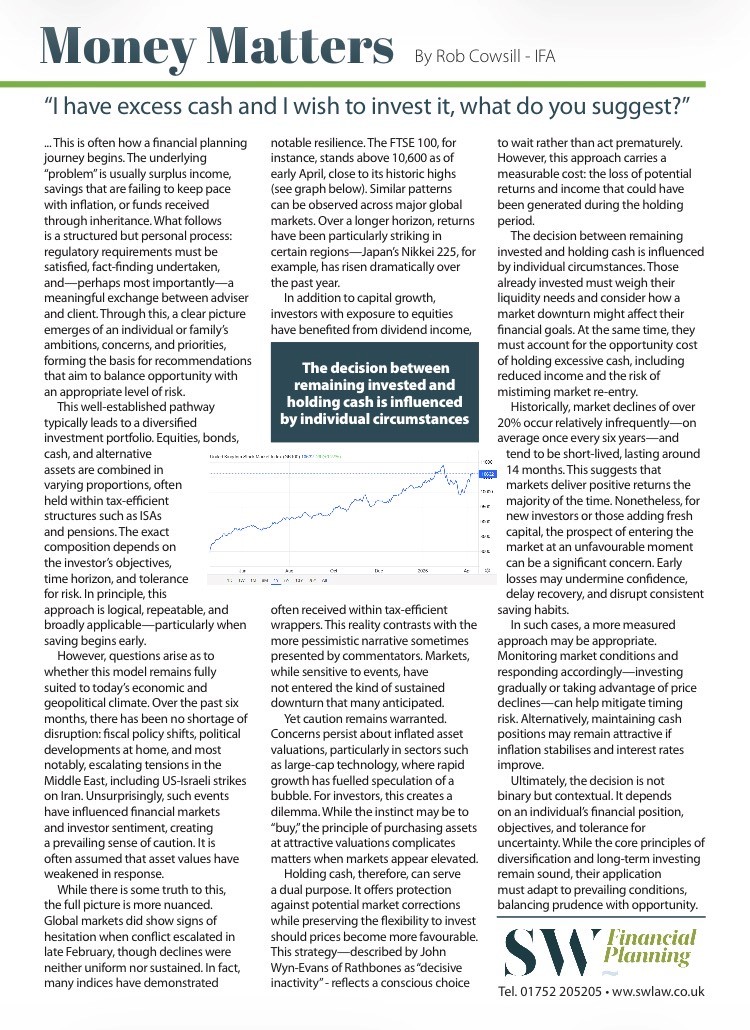
Investment portfolios typically have a UK bias – seeking to mitigate political risk and temper exchange rate risk -, and today (10 April) the FTSE-100 sits at over 10,600 points. Theres only a short period in February and into March 2026 where the ‘blue chip’ index has ever been higher, and this is replicated by many of the major world indices. Alongside the capital uplift investors have benefitted from over this period – Japan’s Nikkei 225 up c. 70%in 12-months is a shining example –, those that have stocks and shares exposure have received passive income in the shape of dividends. Many have often done sowithin a Pension or ISA wrapper free from taxation. Not the negative spiral that commentators and armchair economists portray. “Buy” I hear you shout …
But, the asset ‘bubble’ concern, largely created by themega-cap tech stocks through 2025, still exists.
Investors principally seek to sell-high and buy-low, sothere’s less incentive to buy-in at this time.
Holding cash avoids concerns over an AI led ‘bubble’, butalso provides a fund to buy-in if prices fall – both a defensive and a strategic investment play. Timing the bottom of any market is impossible, I dutifully restate, “there are two types of investor: those who can’t timethe markets and those who don’t know they can’t time the markets”, but the opportunity to acquire ‘good’ assets at a discount to their current value represents a strong long-term strategy. This action, or lack of, is what John Wyn-Evans at Rathbones describes as “decisive inactivity”. The loss of dividend income and/or better returns whilst you wait is the quantifiable cost.
Your position as ‘invested’ or ‘investing’, and the proportion of your wealth this represents, may guide the decision process inthe current economy.
The invested cohort must consider their cash requirement and the impact a market fall could have on their quality of living/goals againstthe risks of excess cash, timing risk and the loss of dividend income. Stock market crashes (falls of over 20%) typically occur once every six-years and last approximately 14 months [only]. Effectively, clients are making positive returns in the markets c. 80% of the time.
Those seeking to contribute new monies or invest for the first time may consider the threat of a market correction as a more significant barrier to entry – starting an investment journey poorly can damage investor confidence, may take significant time to recover from and often disrupts the habitual saving pattern. Instead, ongoing observation may be prudent and enable these individuals to respond to market conditions – move into equities if prices fall and/or take-up cash options if inflation stabilises or returns tick-up.

We strongly believe in the benefits of developing long-lasting relationships with our clients.
We aim to be approachable, easily contactable and offer a broad, inter-discipline, assessment of client needs. We are happy to meet via telephone or virtual meeting, but still prioritise face-to-face meetings where possible.

We work closely across our departments to ensure that specialist knowledge and experience is accessed; when queries arise, there will always be someone available who understands and can deal with your concerns.
We are also keen to work alongside other key stakeholders and individuals; land agents, accountants, your existing solicitor or financial adviser, and of course, your family.

As a firm we are keen to promote and involve ourselves in the community, and to support local charities and initiatives, such as Jeremiah’s Journey, St. Lukes, the Plymouth Argyle Community Trust (Project 35), Emotional Logic and the Ivybridge Brewery.
The South West is a beautiful places to live and we are proud to be based here, we’re therefore keen to help where we can.


Start the process using this form and one of our expert team members will be in touch with you shortly.


